
What is Population Health?
Population health is defined as
the health outcomes
of a group of individuals.
Groups of individuals are often viewed as geographic populations such as residents of a state, county, city or town. A population health approach attempts to understand why some people in the group are healthy and others are not.
A key concept of population health is that many factors influence an individual’s and a community’s health outcomes. The model below illustrates the multiple factors that impact health. Click on this link - County Health Rankings & Roadmaps (University of Wisconsin Population Health Institute) - to explore the model in more detail and to access additional population health resources.
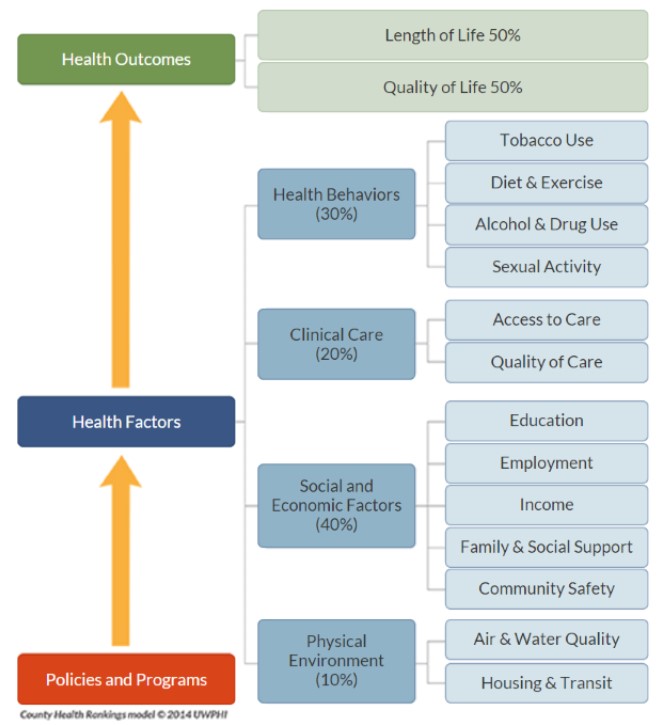
Other key terms associated with population health include:
Social Determinants of Health - the conditions in places where people live, learn, work, and play affect a wide range of health risks and outcomes. For example, differences in health are striking in communities with conditions such as unstable housing, low income, unsafe neighborhoods, or substandard education. Click here to learn more .
Health Disparities – are differences of health outcomes among groups of people. Health disparities adversely affect groups of people who have experienced greater obstacles to health based on their racial or ethnic group; socioeconomic status; gender; age; mental health; disability; sexual orientation; geographic location; or other characteristics linked to discrimination or exclusion. Click here to learn more.
Health Equity – is achieved when all people have full and equal access to opportunities that enable them to lead healthy lives. Click here to learn more.